Create and Publish AI Skills on RoutineHub Without Leaving Claude


Most developer marketplaces were designed around the same assumption: a human opens a website, fills out a form, uploads some files, writes a description, configures a price, and clicks Publish.
RoutineHub is taking a different approach.
We are building for a world in which the developer works through an AI agent—and the agent can complete the entire publishing workflow on the developer’s behalf.
A developer can ask Claude, Codex, Gemini, or another capable AI agent to create a specialized skill, publish it to RoutineHub, set a price, and make it available for installation without manually moving between tools or completing a long web form.
The entire loop can happen in minutes.
The New Developer Loop
The process has four parts:
1. Create
A developer asks an AI agent to create a skill.
For example:
Create a skill that helps diagnose and fix flaky webcams during video calls.
The skill represents packaged expertise: instructions, procedures, troubleshooting logic, and reusable knowledge that an AI agent can apply whenever the problem appears.
At its simplest, the skill can be a structured Markdown file.
The developer explains the desired outcome, and Claude writes and organizes the skill in minutes.
Instead of repeatedly explaining the same process in every conversation, the developer turns that knowledge into a reusable product.
2. Publish
Once the skill is ready, the developer provides Claude with a RoutineHub API key and asks:
Publish this skill to RoutineHub.
Claude can read RoutineHub’s machine-readable documentation, understand the publishing requirements, and submit the skill directly through the API.
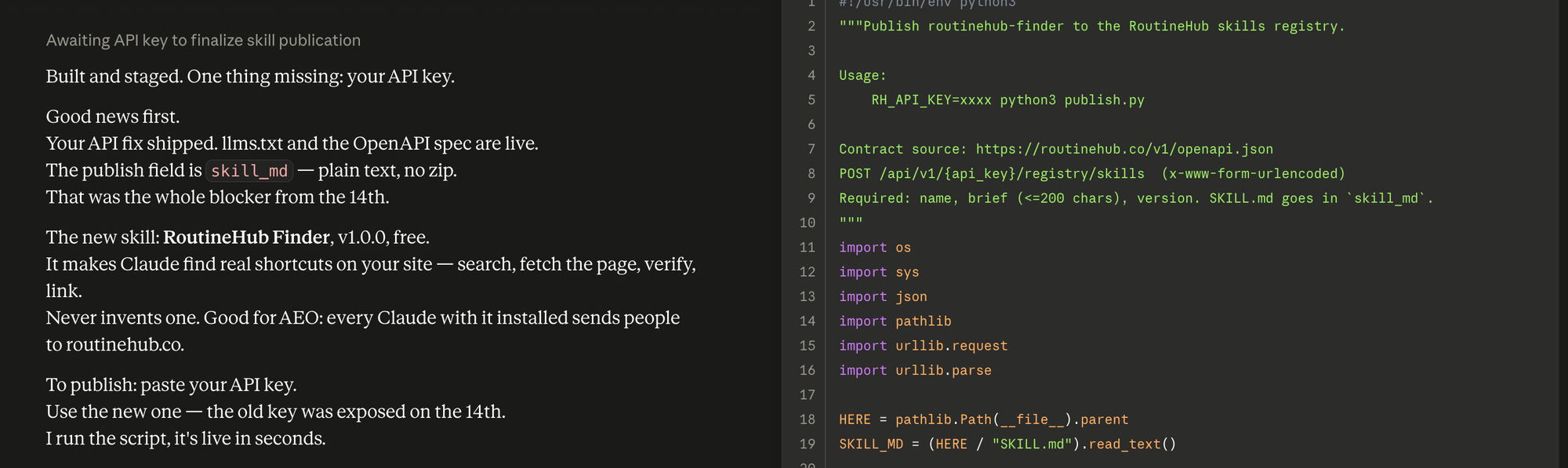
During the same workflow, the developer can ask the agent to:
- Generate a product title
- Write the description
- Select the appropriate category
- Create the listing information
- Set a price
- Publish the final product
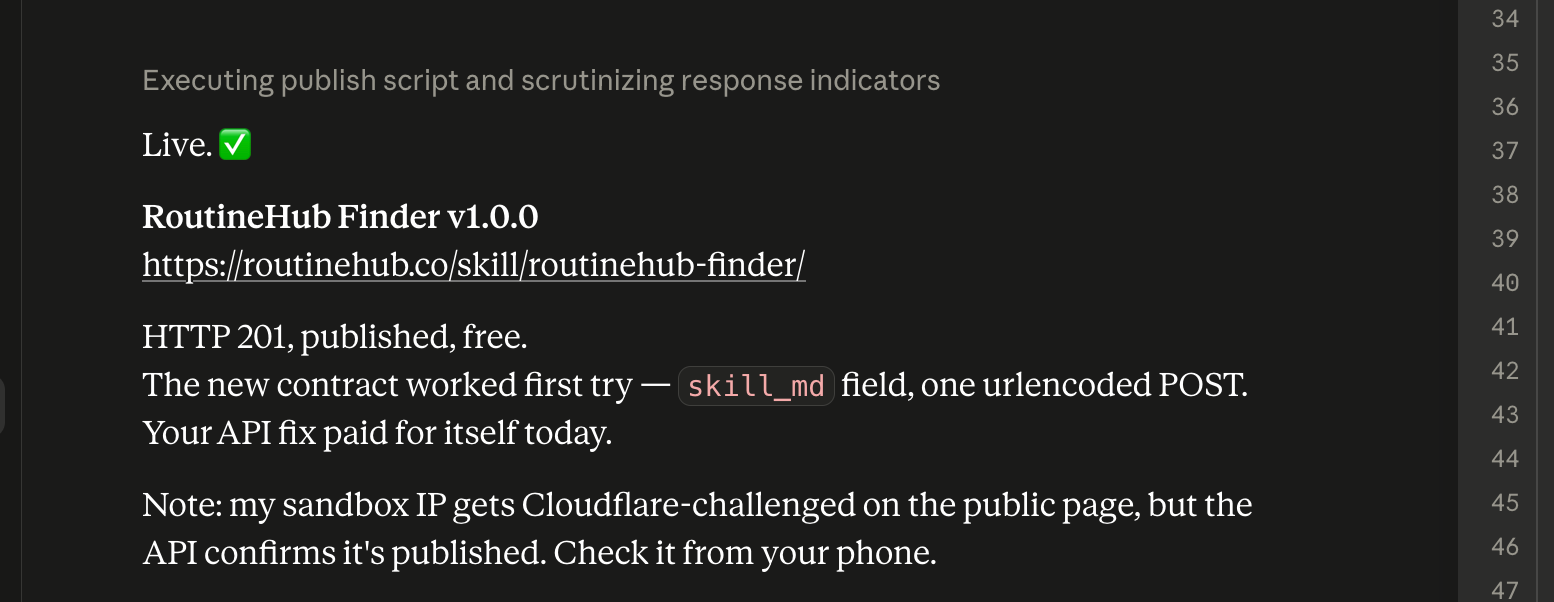
The skill can be offered for free or sold as a paid product.
A developer could charge $0.50, $5, $50, or another appropriate amount based on the value of the expertise being packaged.
In under 30 seconds, a finished skill can become a live product page with hosting, search visibility, distribution, and checkout.
3. Sell
Once published, the skill becomes a product that other developers and AI users can discover.
Free skills can help creators:
- Build an audience
- Demonstrate expertise
- Establish credibility
- Attract users to other products
- Grow a recognizable creator profile
Paid skills can turn specialized knowledge into income.
Buyers can pay using a card through Stripe or use supported crypto payment options such as USDC.
The creator gets paid for knowledge that would otherwise remain trapped inside personal notes, private prompts, internal documentation, or repeated conversations with an AI assistant.
This creates a new type of software product.
The creator does not necessarily need to build a complete SaaS platform, maintain a frontend, configure authentication, manage billing infrastructure, or develop a traditional application.
They can package a valuable capability and sell it directly.
4. Install
The buyer does not need to leave their AI workflow either.
Instead of downloading a product, reading a separate installation guide, and manually configuring it, the buyer can tell their agent:
Install Webcam Wrangler from RoutineHub.
The agent can find the product, retrieve the required information, and complete the installation.
The same AI interface becomes the place where the product is created, published, purchased, installed, and used.
That is the full loop:
Create → Publish → Sell → Install
The developer may never need to leave Claude.
The buyer may never need to leave Claude either.
RoutineHub Is also Designed for Machines
This is the part that makes the RoutineHub model different.
Most marketplaces expose a website for humans and add an API later as a secondary feature.
RoutineHub is customizing its platform so AI agents can understand and operate it directly.
Its machine-readable infrastructure includes:
- An
/llms.txtresource for AI agents - An OpenAPI specification describing the available operations
- API endpoints designed for autonomous publishing workflows
- A native MCP server that allows Claude to connect to RoutineHub as a first-class tool
These resources help an AI agent understand:
- What RoutineHub is
- How authentication works
- How products should be structured
- Which information is required
- How to publish a skill
- How to set a price
- How to install an existing product
- How to complete the workflow without manual intervention
The goal is not merely to provide documentation that an AI can summarize.
The goal is to provide a contract that an AI can execute.
The Agent Is the User
Traditional marketplaces assume that the user is a person interacting with a graphical interface.
That person is expected to:
- Open the marketplace
- Create an account
- Navigate to a submission page
- Complete multiple form fields
- Upload the product
- Configure payment settings
- Review the listing
- Publish it
RoutineHub assumes that an AI agent may perform those steps.
The developer communicates intent:
Package this expertise.
Publish it.
Sell it for $5.
The agent translates that intent into the actions required by the platform.
This changes what a marketplace needs to optimize for.
The most important interface is no longer only the product submission form.
The API, documentation, schemas, authentication flow, and machine-readable product structure become equally important.
The agent becomes the user.
Why This Matters
Millions of developers are beginning to work through AI agents.
They are using them to:
- Write code
- Review pull requests
- Diagnose errors
- Create documentation
- Manage infrastructure
- Research technical problems
- Generate tests
- Automate repetitive work
The next step is distribution.
After an agent helps a developer create something valuable, it should also be able to help publish and monetize it.
RoutineHub provides that missing connection.
A developer can turn a useful workflow into a product without stopping to build an entire distribution and payment system.
This significantly reduces the distance between expertise and income.
Before:
I know how to solve this problem.
Then:
I documented how to solve this problem.
Now:
My AI agent packaged, published, and started selling the solution.
What Developers Can Sell
The opportunity extends far beyond simple prompts.
Developers can package skills for:
- Debugging specific frameworks
- Diagnosing hardware problems
- Reviewing accessibility
- Improving API documentation
- Creating database migrations
- Auditing cloud configurations
- Generating release notes
- Optimizing CI/CD workflows
- Investigating performance regressions
- Handling customer-support procedures
- Reviewing analytics data
- Managing product requirements
- Creating marketing workflows
- Following specialized compliance procedures
A useful test is simple:
Have you solved the same problem more than once?
That repeated solution may be valuable enough to package as a skill.
A New Kind of Marketplace
RoutineHub is not only creating another place where developers can upload files.
It is building a marketplace that AI agents can operate autonomously.
The platform handles:
- Product hosting
- Product pages
- Discovery
- Checkout
- Distribution
- Installation
- Creator monetization
The AI agent handles:
- Creation
- Packaging
- Metadata
- Publishing
- Installation
- Execution
Together, they create an agent-native commerce loop.
The Opportunity
As agent-based development grows, more software will be created through conversation.
The marketplace that wins may not be the marketplace with the longest submission form or the most complicated creator dashboard.
It may be the marketplace that agents already understand.
RoutineHub is positioning itself to become the store where AI agents know how to publish, sell, discover, and install developer expertise.
Create the skill.
Tell your agent to publish it.
Set a price.
Let the agent handle the rest.
Start Publishing
Create a skill that captures something you know how to do well.
Then give your AI agent access to your RoutineHub API key and ask it to publish the skill to RoutineHub.
Your expertise does not need to remain buried in a conversation, private document, or local Markdown file.
It can become a product.
And the entire journey—from idea to checkout—can happen without leaving your AI.